








Sizing a commercial water heater for a business in Redlands is not a guessing game, and it is not something that should be decided by whatever unit happens to fit the mechanical closet. The right system is determined by real hot water demand, peak usage patterns, fixture counts, energy efficiency ratings, and the local code requirements that apply to commercial buildings across San Bernardino County. Working in properties along State Street, Redlands Boulevard, and the Citrus Plaza corridor, our team sees the same pattern repeatedly: undersized systems that cannot keep up during the busiest hours, and oversized systems that quietly drain money through standby heat loss month after month. Getting the sizing right from the beginning protects your operations, your utility budget, and the lifespan of the equipment itself.
Below is a professional breakdown of how commercial water heater sizing actually works, what factors matter most, and where businesses in the Inland Empire most often go wrong.
Understanding Commercial Water Heater Sizing Needs for Your Business
Capacity is the first question we answer on any commercial water heater evaluation, and it starts with daily hot water demand rather than square footage. A 3,000 square foot restaurant on Orange Street and a 3,000 square foot office suite near the University of Redlands have almost nothing in common when it comes to hot water load. What matters is how much hot water your operation actually consumes and how quickly it needs to be replaced.
During an on-site assessment, our licensed commercial plumbers serving Redlands review several variables together:
- Fixture count and type: Every sink, dishwasher, mop basin, laundry connection, and shower that draws hot water contributes to total demand, and commercial fixtures often pull far more volume than residential equivalents.
- Simultaneous use: The critical number is not how many fixtures exist, but how many run at the same time during your busiest stretch of the day.
- Peak usage windows: A cafe near downtown may spike between 6 a.m. and 10 a.m., while a medical office or salon may see steady midday draw. Peak load drives capacity more than daily totals do.
- Recovery rate: This tells us how quickly the unit can reheat incoming water. A smaller tank with a strong recovery rate can sometimes outperform a larger tank with sluggish recovery, depending on the usage pattern.
Undersizing leaves staff waiting on hot water during the exact hours you cannot afford a slowdown. Oversizing means you are paying to keep hundreds of gallons hot that nobody will ever use. Both mistakes cost money, just in different ways.
Unexpected failures compound the problem. When a commercial unit goes down mid-shift, operations stop. That is why businesses across the Inland Empire rely on a plumbing partner that offers responsive commercial water heater repair rather than waiting days for a callback while service is interrupted.
Future growth belongs in the conversation as well. If you are planning to add fixtures, extend hours, expand a kitchen, or build out additional tenant space, we account for that projected load now instead of forcing a full system replacement two years down the road.
Key Factors in Selecting the Right Water Heater Type
Once demand is established, the next decision is what kind of system fits the building. Based on what we see in Redlands commercial properties, the right answer depends on the interaction of four practical factors.
- Energy source: Natural gas, electric, and hybrid or solar assisted systems each carry different operating costs and installation requirements. Gas units typically deliver faster recovery for high-demand operations, while electric units can be the practical choice where gas service is limited or venting is restricted. In older buildings around downtown Redlands, existing gas line capacity often becomes the deciding factor, and that needs to be verified by a professional before equipment is ordered.
- Size and capacity: A unit that cannot keep pace creates service delays and frustrated customers. A unit that is dramatically overbuilt burns energy maintaining water nobody draws. The goal is a system matched to measured demand with sensible headroom, not a rounded-up guess.
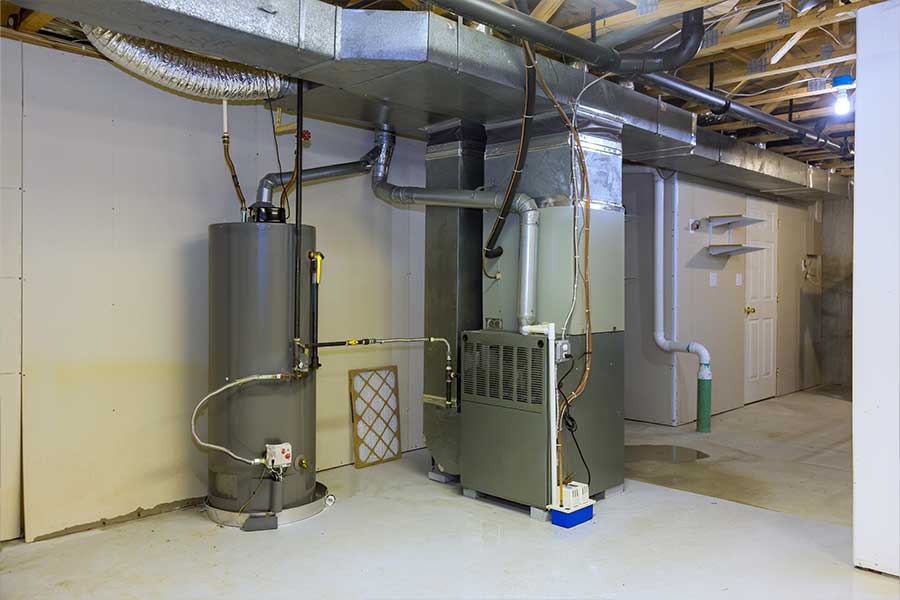
- Available installation space: Mechanical rooms in many Redlands commercial buildings, particularly in the older converted structures near the historic downtown district, were never designed for modern high-capacity equipment. Clearance requirements, venting paths, combustion air, and code-required service access all limit what can realistically be installed. This is one of the most common reasons a system selected on paper fails inspection in the field.
- Maintenance requirements and warranty coverage: Commercial warranties frequently require documented professional maintenance to stay valid. Understanding those obligations upfront, along with the realistic service interval for your water conditions, prevents an expensive surprise when a component fails in year four.
For businesses weighing a full replacement, our team handles the complete evaluation and commercial water heater installation process, including load calculation, equipment selection, venting, and code compliance from start to finish.
Calculating Your Business’s Hot Water Demand
Accurate demand calculation is the foundation of the entire project. In our service calls throughout Redlands, this is the step that most often gets skipped, and it is the step that determines whether the system performs for a decade or struggles from day one.
A proper commercial assessment accounts for the following:
- Peak usage time. We identify the window when hot water consumption is highest, whether that is a morning rush, a dinner service, a shift changeover, or a scheduled cleaning cycle. Systems are sized for peak, not average.
- Total fixture count. Every hot water fixture is inventoried, including the ones easy to forget such as utility sinks, employee break rooms, and back-of-house wash stations.
- Average draw per fixture. Commercial dishwashers, three-compartment sinks, and sanitizing equipment consume dramatically more hot water than standard fixtures, and each is calculated at its actual rated demand rather than a generic estimate.
- Simultaneity factor. Realistic overlap is applied so the system is sized for genuine concurrent use rather than a theoretical worst case that would never occur.
Water quality plays a significant role here too. Much of the Inland Empire, including Redlands, Highland, and Yucaipa, is served by notably hard water. Working in commercial buildings across this region, we routinely open tanks and see substantial scale accumulation on heating elements and tank bottoms. That mineral buildup insulates the heating surface, slows recovery, forces the burner or elements to run longer, and shortens equipment life considerably.
For many commercial properties, pairing a new water heater with commercial water softener installation is the single most effective way to protect the investment. Treated water reduces scale, preserves rated recovery performance, and keeps maintenance intervals predictable rather than reactive.
Energy Efficiency Ratings: What You Should Know
Efficiency ratings translate directly into operating cost, and with Southern California utility rates where they are, the difference between a marginal unit and a high-efficiency unit shows up on every bill.
Here is what those ratings actually mean:
- Energy Factor (EF): Measures how efficiently the unit converts fuel or electricity into usable hot water. Higher numbers indicate better conversion and lower operating cost.
- Uniform Energy Factor (UEF): The current standard, and a more complete measurement. UEF accounts for standby heat loss and recovery efficiency alongside conversion, which makes it far more useful for comparing commercial equipment realistically.
- ENERGY STAR certification: Confirms the model meets efficiency thresholds established by the EPA. For commercial buyers, certified equipment also frequently qualifies for utility rebate programs.
Standby loss deserves particular attention in Redlands, where mechanical rooms in buildings along the Interstate 10 corridor can run extremely warm through long stretches of summer heat. Insulation quality, venting design, and tank placement all influence how much energy is lost simply maintaining temperature between draws.
Demand-type systems are worth evaluating as well. Because they heat water only as it is called for, tankless water heater systems eliminate standby loss entirely and can be configured in banks to serve higher commercial loads. They are not the right answer for every operation, and the decision depends on gas supply capacity, venting, flow rate requirements, and usage pattern. That assessment should be made by a licensed commercial plumber who has evaluated your building, not by comparing spec sheets.
Common Commercial Water Heater Installation Mistakes to Avoid
Commercial water heater installation carries requirements that go well beyond connecting supply lines. These are the failures we are most frequently called in to correct across Redlands and surrounding Inland Empire communities.
1. Incorrect sizing. This remains the most expensive mistake in the category. An undersized system leaves your business without hot water during peak operation, while an oversized system inflates utility costs permanently. Correct sizing requires a documented load calculation, not a replacement matched to whatever was previously in the room.
2. Ignoring local codes and permitting. Commercial water heater installations in Redlands are subject to city permitting, seismic strapping requirements, expansion control, temperature and pressure relief discharge routing, and clearance standards. Non-compliant work can result in failed inspection, fines, insurance complications, and a required tear-out and reinstall. Licensed installation with pulled permits protects the building owner from all of it.
3. Improper venting and combustion air. Inadequate venting on a gas-fired commercial unit is a genuine safety hazard, not just an efficiency concern. Flue sizing, vent material, termination clearances, and combustion air supply all have to be engineered correctly for the specific equipment and the specific mechanical space.
4. Overlooking water quality and system protection. Installing a new high-efficiency unit on untreated hard water without expansion control or scale protection puts the equipment on a shortened clock from the first day of operation.
5. Skipping the commissioning and documentation step. Proper startup, temperature calibration, recirculation balancing, and warranty registration all matter. Without them, performance suffers and warranty claims get denied.
Getting Commercial Hot Water Right in Redlands
A commercial water heater is infrastructure, not an appliance. When it is properly sized, correctly installed, and protected against the hard water conditions common throughout Redlands and the surrounding Inland Empire, it runs quietly in the background for years. When any one of those steps is handled carelessly, the result is interrupted service, inflated utility bills, and premature replacement.
Pride Plumbing, Drain Cleaning & Water Heater Repair has built its reputation on getting this work right the first time. As a women-owned, family-oriented company with more than 240 five-star Google reviews, we treat every commercial property we service the way we would treat our own. Our certified plumbers handle load calculations, equipment selection, permitting, installation, and ongoing maintenance for businesses across Redlands, Highland, Yucaipa, Loma Linda, San Bernardino, Riverside, and the wider Inland Empire. Same-day appointments are available, and our 24/7 emergency service means a failed commercial water heater never has to become a full day of lost revenue.
If you are planning a replacement, opening a new location, or dealing with a system that no longer keeps up with demand, contact our team today to schedule a commercial water heater assessment and get straightforward guidance on the right system for your business.